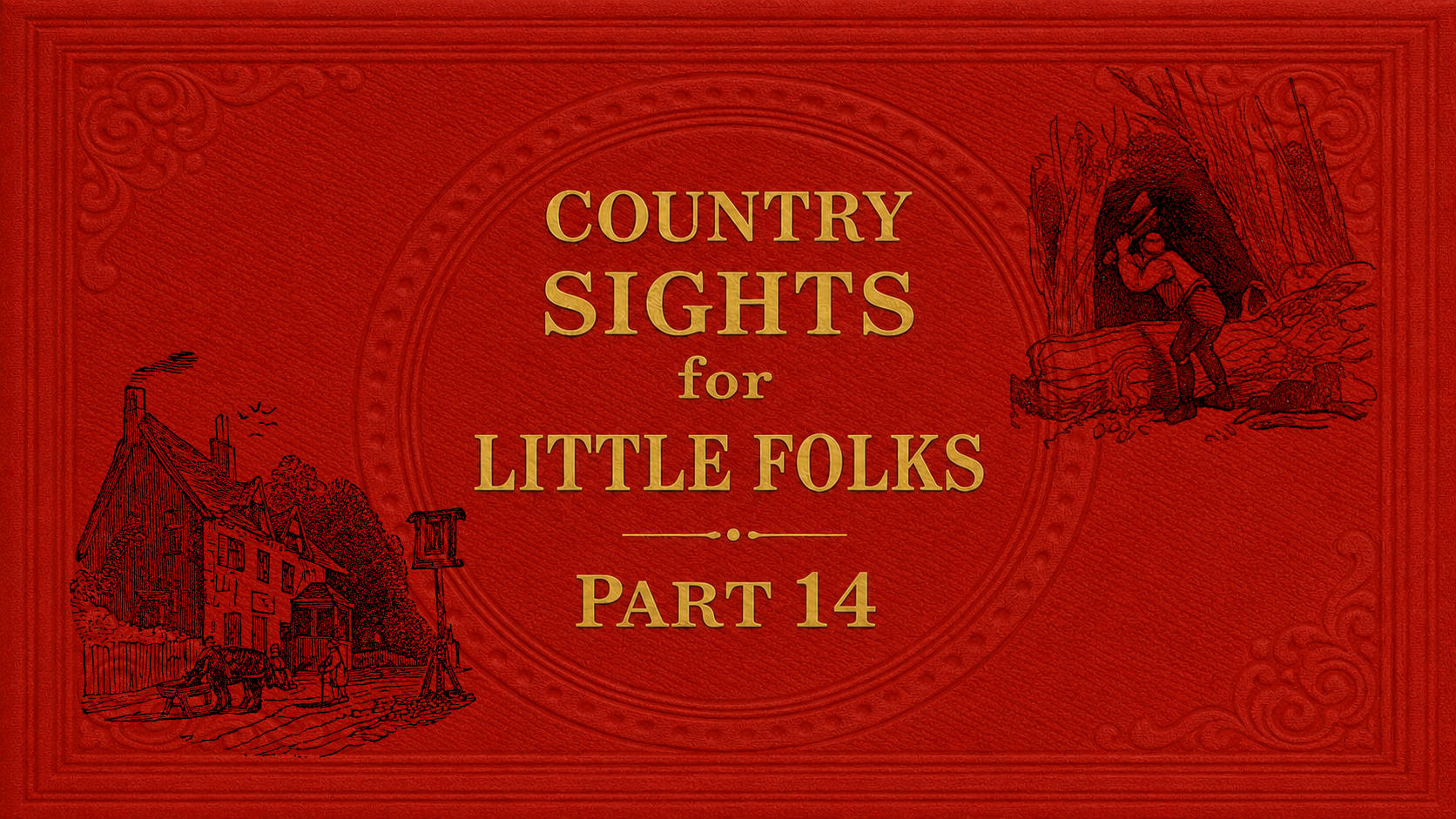
Country Sights for Little Folks
Part 14
THE WOODMAN
 The man in the cut has taken down a tree, and is at work with his axe lopping the stubs and branches. There is skill as well as strength required for felling heavy timber. The woodman observes first which way the tree leans, and cuts with the axe, or a cross-cut saw, according to the side on which he sees it will descend. He takes care, too, to lop off such of the principal branches as might give it a wrong direction, or cause the tree to split up the trunk. It is very common to tie a long rope to the top, and when the tree is nearly cut through, the men get to a little distance and rock the mighty oak or elm backwards and forwards, until with a thundering crash it falls! When it lies prostrate, we are generally surprised at the vast dimensions of those arms which once waved like fathers in the wintry storm.
THE COUNTRY INN
 “Stop, stranger, if you please, awhile,
You ’ve travell’d many a weary mile,
Refresh yourself, refresh your horse,
Then blithely speed you on your course;
I’ve Truman, Hanbury’s entire,
’T is mild, or old, at your desire;
Or bottled ale, or bottled stout,
Up and alive, you need not doubt,
Tobacco, pipes, and weekly news,
And right companions if you choose.
But if you’re too genteel and snug
To like a neighbour with your mug,
Why, there’s a room with window bow’d,
Which looks both up and down the road;
And Betsy, waits, with look demure,
Your worship’s comfort to insure;
She’ll light the fire, a curtsey drop,
And cook your chicken or your chop;
And not till twice you’ve told your will,
Will I, your host, produce your bill.
So, stranger, step you in a while;
You’ve travell’d many a weary mile;
Refresh yourself, refresh your horse,
Then blithely speed you on your course.”
Did You Know?
- Falling a tree was a carefully planned job, not just brute strength. Experienced woodmen studied a tree’s lean, weight, and branch structure before making the first cut. A mistake could cause the tree to split unexpectedly or fall in the wrong direction, making logging one of the most dangerous occupations of its day.
- “Truman, Hanbury’s Entire” was a famous English beer. The poem refers to a popular style of beer brewed by Truman, Hanbury, Buxton & Co., one of the largest breweries in the world during the late 1800s.
- King Richard II passed an Act making it compulsory for pubs and inns to have a sign. Before house numbers became common, travelers identified inns by their painted signs, such as The Red Lion, The King’s Head, or The White Hart. These colorful signs made it easy for travelers, including those who could not read, to recognize an inn from a distance.