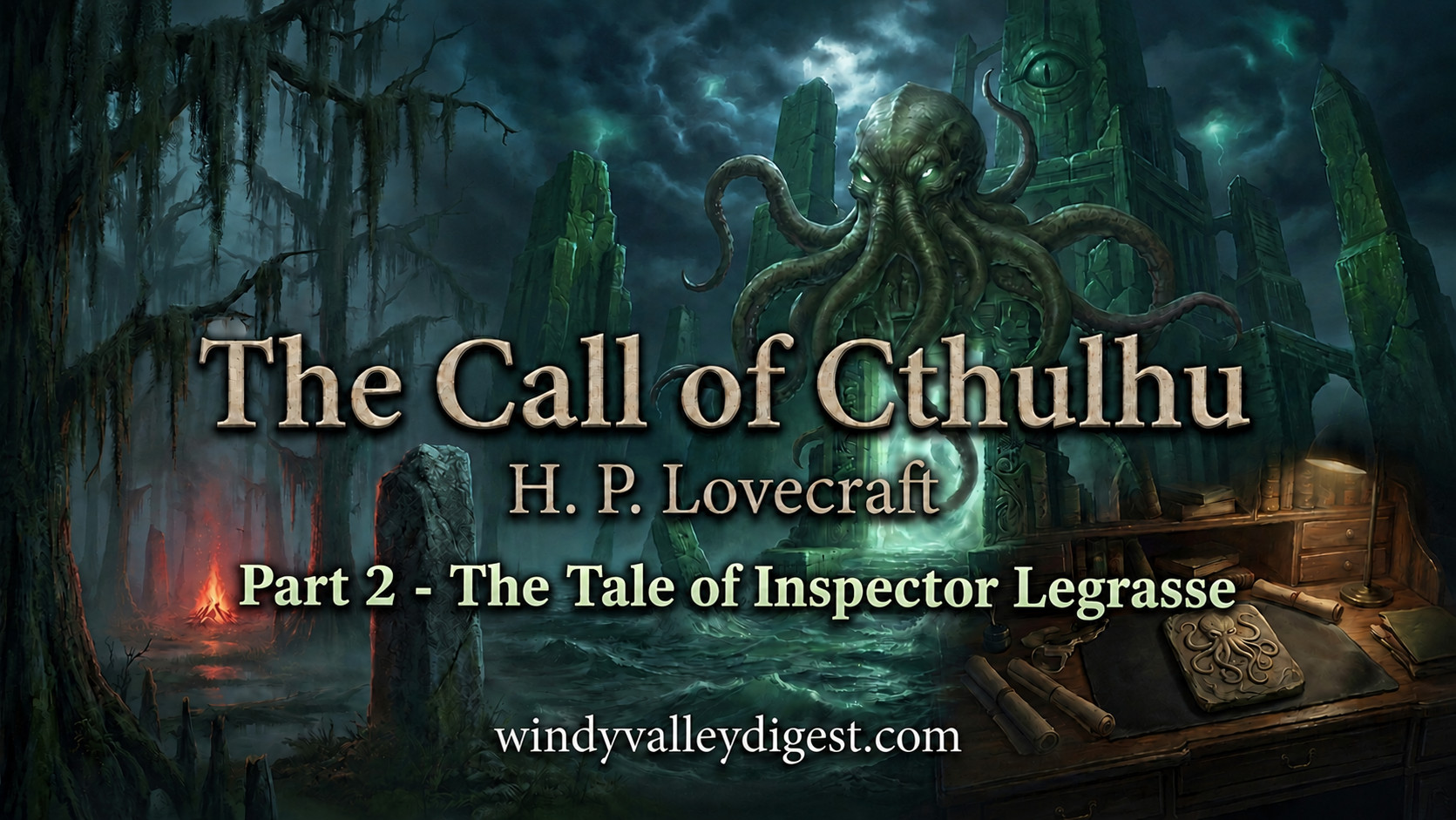
The Call of Cthulhu
Part 2: The Tale of Inspector Legrasse
by H. P. Lovecraft
Through Lovecraft’s blending of detective fiction, anthropology, and supernatural horror, the chapter explores how established systems of knowledge can falter when confronted with evidence that refuses to fit within familiar explanations. The narrative also introduces a central tension in Lovecraft’s work: the conflict between rational skepticism and the possibility that reality may be far stranger than human reason allows.
As the pieces of the mystery accumulate, what begins as an inquiry into the past raises increasingly troubling questions about humanity’s place in a much older and less comprehensible universe.
Fragments of the Unknown
- Lovecraft describes the Louisiana swamp settlers as descendants of Lafitte’s men. Jean Lafitte was a real-life privateer and smuggler who operated along the Louisiana coast in the early 1800s. Some of his associates, known as the Baratarians, even helped defend New Orleans against British forces during the War of 1812. Lovecraft’s claim about the settlers’ ancestry is fictional, but it draws on the region’s genuine pirate history.
- Lafcadio Hearn published an article titled New Orleans Superstitions in Harper’s Weekly on December 25, 1886. His account recorded local beliefs about charms, protective rituals, and supernatural harm, showing that the region’s folklore was being documented decades before Lovecraft wrote his story.
- Lovecraft refers to an Inuit religious practitioner using the historical spelling “angekok.” Inuit communities have long had traditions of spiritual specialists, commonly called angakkuq in modern transliteration, who served religious and social roles. However, Lovecraft’s fictional cult is not an accurate representation of Inuit religion.
- Inspector Legrasse presents his mysterious idol at a 1908 meeting of the fictional American Archaeological Society. A real organization, the Archaeological Institute of America, had been founded in 1879 and was already holding annual meetings by the late nineteenth century. Lovecraft’s fictional gathering reflects the growing popularity of organized archaeology and scholarly research during this period.
Should you wish to revisit the earlier revelations of this strange and disturbing account, Part 1: The Horror in Clay awaits. For those who would trace the entire sequence of these disturbing occurrences, the table of contents provides the path.
Notes
Links
- Facebook page.
- Visit, “like” and “follow” to get up to date news and information about The Windy Valley Digest
- YouTube Channel.
- Watch our illustrated audio books.
- Don’t forget to hit the thumbs up, subscribe and click the bell icon to be notified when new videos are available.
- Rumble Channel:
- Our channel mirror if you don’t do the Youtube thing.
Credits
- Read by: Phil Chenevert
- Book Coordinator: Phil Chenevert
- Meta Coordinator: Phil Chenevert
- Proof Listener: Larry Wilson
- Video Editor: Vincent Cowley
- Video Producer: Vincent Cowley
- Graphics Assistance”
- Gemini Notebook
- ChatGpt